
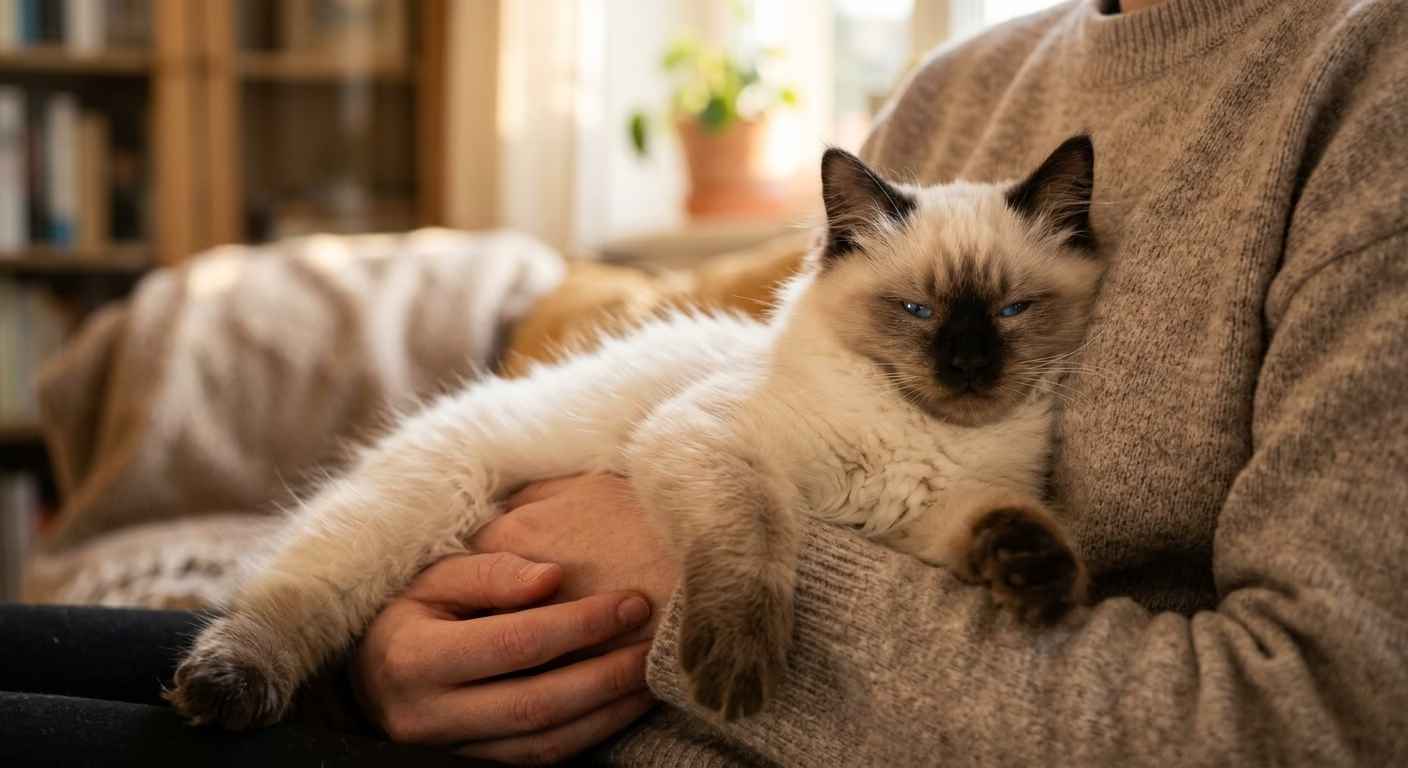
If you have ever watched your cat rhythmically push her paws into a blanket, your lap, or another cat, you have witnessed one of the most charming behaviors in the feline world. Cat lovers call it making biscuits, kneading dough, or simply happy paws. It happens in every breed, at every age, and almost always comes with a dreamy, half-closed-eyes expression. But why do cats actually knead?
Short answer: cats knead because the behavior is wired into them from kittenhood, when nursing cats push against their mother’s belly to stimulate milk flow. Adult cats keep doing it as a self-soothing habit, a way to show contentment, a scent-marking behavior, and sometimes as a social invitation to the humans or other cats they love. There is no single reason; most cats do it for a mix of all of these.
The 5 scientific explanations for why cats knead
1. It is a leftover from nursing
The leading theory, and the one every veterinary behaviorist agrees on, is that kneading begins in the first week of life. Newborn kittens knead their mother’s mammary glands to stimulate milk letdown. The rhythm is instinctive, hardwired before kittens can even open their eyes. The behavior is strongly associated with warmth, safety, and feeling full, which is why cats return to it throughout their lives whenever they feel the same way. If your cat kneads your lap while you are petting her, she is replaying one of the happiest states she has ever been in.
2. It is a self-soothing routine
Behavioral research on domestic cats consistently shows that kneading releases a mild calming effect similar to a person tapping their foot or stroking their own forearm. Cats will often knead before settling down to sleep, during long petting sessions, or when they are hearing a familiar voice. The rhythmic pressing is part of how they regulate themselves. Watch any cat kneading and you will see the shoulders drop and the breathing slow within about thirty seconds; the behavior literally relaxes them.
3. It is scent-marking
Cats have scent glands in the pads of their paws. When they knead a surface, they are depositing a thin layer of their individual scent onto it. From the cat’s point of view, this is marking that spot as mine. If your cat kneads your legs, blanket, or favorite chair, she is literally telling the household: this belongs to me now. Cats living in multi-cat homes often knead the same spot more than cats living alone, which fits the territorial theory.
4. It is a social greeting
Kittens learn to associate kneading with physical closeness to their mother and littermates. Adult cats transfer that association to their chosen humans or bonded cat companions. If your cat approaches you, climbs into your lap, and starts kneading right away, she is extending the strongest social affection a cat has in her repertoire. The behavior shows up most often with the person the cat has decided is her primary human.
5. It is a nesting instinct
Wild cat ancestors would paw at tall grass or leaf litter before lying down, flattening it into a comfortable sleeping shape and checking for anything hidden underneath. Domestic cats carry the instinct forward even on soft beds and couches. If your cat circles, kneads her sleeping spot for twenty or thirty seconds, and then flops down, she is doing exactly what her wild ancestors did ten thousand years ago.
What your cat’s kneading is telling you
Not every kneading session means the same thing. Pay attention to the context and body language and you can usually read what your cat is communicating.
| Context | What she is likely saying |
|---|---|
| Kneading your lap while being petted, with purring | I am completely safe and happy with you |
| Kneading a blanket before lying down | Preparing a nest for sleep |
| Kneading another cat she lives with | Reinforcing a bonded relationship |
| Kneading with eyes closed and slow blinks | Deep contentment, same as a human sigh of relief |
| Intense kneading with suckling on fabric | Early-weaned behavior; usually harmless but may indicate she was taken from mother too young |
| Kneading right before jumping down and leaving | Scent-marking you before moving on |
| Kneading a new object (bag, suitcase, laundry) | Investigating and claiming unfamiliar territory |
Why some cats knead more than others
Three factors determine how much a cat kneads: when she was weaned, her personality, and her breed.
Early weaning increases kneading. Kittens placed with new families before 10 weeks tend to knead more throughout their lives because the behavior that normally fades gradually as they grow stays strong. At Luxury Only Kittens, every kitten is placed between 12 and 16 weeks for exactly this reason: full weaning, complete socialization, and emotionally stable adults. Early-weaned kittens from less careful sources often grow into enthusiastic kneaders.
Personality drives frequency. Confident, bonded, people-focused cats knead more. Reserved or anxious cats knead less, often because they rarely enter the fully relaxed state kneading requires.
Some breeds are famous for it. If you want a cat who makes biscuits several times a day, breed matters.
Breeds most known for kneading
- Ragdoll: arguably the champion kneaders. Ragdolls bond deeply with one or two humans and will knead the moment they settle into a lap. Browse our Ragdoll kittens to see the breed up close.
- Maine Coon: big cats, big paws, big kneading. Maine Coons knead with the same gentle rhythm as any other cat but at twice the scale. See the Maine Coon breed guide for more.
- Birman: gentle, affectionate, and very likely to knead their chosen person during every lap session.
- Siberian: rhythmic, confident kneaders; often start kneading before they are fully in your lap.
- Scottish Fold: famously social and famously fond of kneading, usually while sitting in the Buddha pose with hind legs stretched out.
British Shorthairs, by contrast, knead less than most breeds. They show affection through proximity rather than physical pressing. If you want a cat who sits regally near you rather than one who kneads you insistently, the British Shorthair is a better fit.
When kneading becomes a problem (and what to do)
Most kneading is harmless and welcome. A few situations warrant intervention.
Claws that hurt: some cats keep their claws extended during kneading. If the kneading breaks skin or snags clothing, keep her claws trimmed, place a thick blanket between her paws and your lap, and gently redirect her onto a dedicated kneading mat or soft toy. Never punish the kneading itself; it is pure affection and shutting it down damages your bond.
Compulsive wool-sucking: some cats combine kneading with sucking on fabric, often wool or soft blankets. This is more common in cats weaned too early or in high-strung breeds. In small doses it is harmless. If your cat is eating fabric fibers or doing it for hours a day, consult your vet; chronic fabric-sucking can indicate anxiety or a condition called pica.
Kneading combined with signs of distress: if kneading comes with excessive vocalization, hiding, or appetite loss, the behavior may be a self-soothing response to pain or stress, not contentment. A vet visit is warranted.
Should you let your cat knead you?
Yes. Kneading is the clearest signal a cat gives that she trusts her human. Interrupting it, pushing her away, or scolding her teaches her that affection is risky. If the claws are a problem, address the claws; do not address the kneading. Trim nails every two weeks, keep a dedicated blanket on your lap for kneading sessions, and enjoy the fact that your cat has chosen you as the person worth making biscuits for.
Looking for a kitten who will knead you every evening?
If you want the full lap-cat experience, prioritize breeds known for kneading and work with a breeder who weans properly. At Luxury Only Kittens, every placement comes from a cattery that keeps kittens with their mother for at least 12 weeks. Browse our currently available kittens to see which Ragdolls, Maine Coons, Birmans, Siberians, and Scottish Folds are ready for placement.
Frequently asked questions
Why does my cat knead me and then bite me?
The sequence of kneading followed by a nip is usually overstimulation. Your cat starts in a happy, relaxed state, builds up gentle excitement through the rhythmic kneading, and crosses a threshold where the sensation becomes too much. The nip is her way of saying enough. Watch for subtle signs: tail twitching, ears rotating backward, skin rippling. Stop petting as soon as you see these and the bite will not come.
Why do cats knead with just their front paws?
Most cats knead with their front paws only because that is the muscle pattern they learned as nursing kittens, when only the front paws reached the mother’s belly. A small percentage of cats knead with all four paws, usually when they are kneading a soft bed they are nesting into.
Do cats knead when they are in pain?
Rarely. Kneading is a contentment behavior in almost every case. The exception is a cat kneading at an unusual spot on her own body (over the belly, for example), which can signal discomfort. If kneading is combined with hiding, appetite loss, or vocalization, consult a vet.
Why does my cat knead and purr but seem to be drooling?
Drool during kneading is actually a strong contentment signal. Some cats are so deeply relaxed by the combination of being petted, purring, and kneading that saliva production increases and a small amount escapes. It is harmless and considered a sign of a very happy cat.
Can I train my cat to stop kneading?
You can redirect the behavior onto a specific surface, like a kneading blanket on your lap, but you cannot eliminate it. Kneading is instinctive. Suppressing it entirely is bad for the cat and bad for your relationship. If a specific behavior inside the kneading (claws, biting, wool-sucking) is the real problem, address that specific behavior rather than the kneading itself.
Why does my male cat knead more than my female?
There is no scientifically established link between sex and kneading frequency. The variation is mostly individual personality and early-weaning history. Male and female cats of the same breed, from the same breeder, often show opposite kneading patterns based on temperament alone.
At what age do kittens start kneading?
Kittens begin kneading within hours of birth, long before they can see or hear. The behavior is one of the first motor patterns to develop. By the time a kitten is 8 weeks old, kneading is already a settled daily habit. By 12 to 16 weeks (the age at which Luxury Only Kittens places all kittens into their new homes), it is a core part of how they express affection.
Do all cat breeds knead?
Yes, every domestic cat breed kneads, from Sphynx to Persian. Frequency varies by breed and individual, but the behavior itself is universal. If a cat never kneads at all, it is worth asking a vet whether early-life stress or health issues are suppressing the behavior.